OSHA today announced a final rule to improve protections for workers exposed to respirable silica dust. The rule will curb lung cancer, silicosis, chronic obstructive pulmonary disease and kidney disease in America's workers by limiting their exposure to respirable crystalline silica.
"The previous exposure limits were outdated and did not adequately protect workers," said OSHA Assistant Secretary Dr. David Michaels. "Limiting exposure to silica dust is essential. Every year, many exposed workers not only lose their ability to work, but also to breathe. Today, we are taking action to bring worker protections into the 21st century in ways that are feasible and economical for employers to implement."
 About 2.3 million men and women face exposure to respirable crystalline silica in their workplaces, including two million construction workers who drill and cut materials such as concrete and stone, and 300,000 workers in operations such as brick manufacturing, foundries and hydraulic fracturing. OSHA estimates that when the final rule becomes fully effective, it will save more than 600 lives annually and prevent more than 900 new cases of silicosis – an incurable and progressive disease – each year. The agency also estimates the final rule will provide net benefits of about $7.7 billion per year.
Most employers can limit harmful dust exposure by using equipment that is widely available – generally using water to keep dust from getting into the air or a ventilation system to remove it from the air. The rule provides greater compliance assistance to construction employers – many of which run small businesses – by including a table of specified controls they can follow to be in compliance. The rule also staggers compliance dates to ensure employers have sufficient time to meet its requirements.
The final rule is written as two standards, one for construction and one for general industry and maritime. In addition to reducing the permissible exposure limit for crystalline silica, the rule includes employer requirements such as limiting worker exposure through work practices and engineering controls (such as water or ventilation); providing respiratory protection when controls are insufficient; training workers; limiting their access to high exposure areas and providing medical exams to highly exposed workers.
For more information, see the news release—available in English and Spanish—and a blog post by U.S. Secretary of Labor Thomas E. Perez, which includes a video featuring one worker's personal experience with silicosis. Visit OSHA's silica rule webpage for factsheets, answers to frequently asked questions, and to sign up for email updates on compliance dates and resources.
 OSHA reminds employers of their obligation to post a copy of OSHA's Form 300A, which summarizes job-related injuries and illnesses logged during 2015. The summary must be displayed in a common area where notices to employees are usually posted each year between Feb. 1 and April 30.
Businesses with 10 or fewer employees and those in certain low-hazard industries are exempt from OSHA recordkeeping and posting requirements. As of Jan. 1, 2015, certain previously exempt industries are now covered. Lists of both exempt and newly coveredindustries are available on OSHA's website. Visit OSHA's Recordkeeping Rule webpage for more information on recordkeeping requirements.
 While aerial lifts are used frequently at construction, warehousing, and many other jobsites, they can pose potentially fatal hazards to workers. Aerial devices include boom-supported aerial platforms, such as cherry pickers or bucket trucks, aerial ladders and vertical towers.
The major causes of injuries and fatalities are falls, electrocutions, and collapses or tip-overs, such as the one that killed Kevin Miranda in Taunton, Mass., on Aug. 18, 2015. Skyline Contracting and Roofing Corp. was fined more than $100,000 after OSHA inspectors found that the aerial lift was positioned on unleveled ground and determined that the company had not trained Miranda to recognize this hazard.
Learn about the fall-related risks and recommended safe work practices associated with this equipment by visiting the new NIOSH Aerial Lifts webpage. The page includes a Hazard Recognition Simulator designed to help you acclimate to aerial lift operation. Additional resources on aerial lift safety are available from OSHA.
 Climbing for work? NIOSH's award-winning Ladder Safety app, first released in 2013 to provide user-friendly guides and interactive tools for extension ladder selection and safe use, now includes step ladder safety resources and other enhancements based on user input. Download the free app, available in English and for iPhone/iPad or Android. Visit the NIOSH Ladder Safety Mobile Application webpage to learn more.
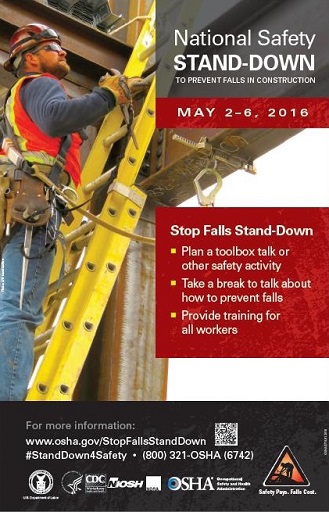 OSHA, the National Institute for Occupational Safety and Health and the Center for Construction Research and Training have announced May 2-6, 2016, as the official week for the third annual National Safety Stand-Down. The event is a nationwide effort to remind and educate employers and workers in the construction industry of the serious dangers of falls that remain the leading cause of death in the industry. Employers are encouraged to pause during their workday for topic discussions, demonstrations, and training on how to recognize hazards and prevent falls.
More than four million workers participated in the National Safety Stand-Down in 2014 and 2015. OSHA expects thousands of employers across the nation to join the 2016 event. To guide their efforts, OSHA hosts the official National Safety Stand-Down website with information on conducting a successful stand-down, including the 2016 Stand-Down video.
The National Safety Stand-Down in 2016 is part of OSHA's ongoing Fall Prevention Campaign, which provides employers with lifesaving information and educational materials on how to take steps to prevent falls, provide the right equipment for their workers and train all employees on its proper use. For more information, see the news release.
 As part of the Occupational Safety and Health Administration's efforts to protect workers from the hazards of chemicals, the agency plans to issue new guidance on how to apply the Weight of Evidence approach when dealing with complex scientific studies. On February 16, OSHA will begin accepting comments on its Guidance on Data Evaluation for Weight of Evidence Determination*, which is intended to help employers consider all available information when classifying hazardous chemicals.
The "weight of evidence" approach assists manufacturers, importers and employers to evaluate scientific studies on the potential health hazards of a chemical. It aids in determining what information must be disclosed on the label and safety data sheet for compliance with the Hazard Communication Standard. This draft is a companion document to a recently posted Hazard Classification Guidance* and is intended to help the label and safety data sheet preparer apply the approach when dealing with complex scientific studies.
 OSHA has posted a new Hazard Alert on Working Safely with Scissor Lifts*, which was developed after a student was killed while filming from a scissor lift in 2010. The alert describes and encourages the safe use of scissor lifts through three proactive focus areas—fall protection, stability, and positioning.
OSHA has a new webpage explaining employers' obligations to provide all workers with sanitary and immediately-available toilet facilities. OSHA's sanitation standards are intended to ensure that workers do not suffer adverse health effects that can result if toilets are not sanitary and/or are not available when needed. The webpage includes information on the minimum number of toilet facilities an employer must provide, in restrooms separate for each sex. The webpage also includes a link to OSHA's recent best practices publication, A Guide to Restroom Access for Transgender Workers*.
OSHA recently certified New Jersey's State Plan for protecting the safety and health of state and local government workers. The New Jersey Public Employees Occupational Safety and Health State Plan covers more than 530,000 state and local government workers. The New Jersey State Plan was initially approved in January of 2001 and certification became effective on Jan. 22, 2016. This certification, which was published in the Federal Register, attests to the fact that New Jersey now has in place all those structural components necessary for a State Plan covering state and local government workers. For more information, see the news release.
OSHA is introducing more durable and secure completion cards for its Outreach Training Programs, including 10-hour and 30-hour voluntary safety classes for workers in construction, maritime, and general industry. The classes, which help workers learn how to identify and prevent workplace hazards, are not required by OSHA although some cities and employers do require workers to complete them. The classes are taught by independent consultants authorized by OSHA and trained through OSHA Training Institute Education Centers.
At the conclusion of each course, students receive completion cards, which are currently printed on paper. After February 29, completion cards will be made of a more durable card stock, like a credit card - with a QR code that will include the student name, trainer name, date of issue, and the OTI Education Center that produced the card. OTI Education Centers will charge $8 each for the new cards, compared to $5 for the current paper cards. The new cards will be issued for in-person training sessions only; students who complete online training will continue to receive paper cards at this time. Workers who already have 10-hour and 30-hour cards do not need to change over to a new card. For more information, visit OSHA's voluntary Outreach Training Programs webpage.

 OSHA today announced a final rule to improve protections for workers exposed to respirable silica dust. The rule will curb lung cancer, silicosis, chronic obstructive pulmonary disease and kidney disease in America's workers by limiting their exposure to respirable crystalline silica.
 About 2.3 million men and women face exposure to respirable crystalline silica in their workplaces, including two million construction workers who drill and cut materials such as concrete and stone, and 300,000 workers in operations such as brick manufacturing, foundries and hydraulic fracturing. OSHA estimates that when the final rule becomes fully effective, it will save more than 600 lives annually and prevent more than 900 new cases of silicosis – an incurable and progressive disease – each year. The agency also estimates the final rule will provide net benefits of about $7.7 billion per year.